What you see isn't real: How brains actually perceive things
Look around you. As you scan the surrounding scene and form the crisp, detailed view of your environment, I want you to realize that what you’re seeing isn’t actually real. It’s actually a “guess”.
Yes, you heard that right. What you’re seeing isn’t technically real. It’s literally a hallucination, a best guess, a fabricated illusion - whatever you want to call it, it’s simply an internally generated model that feels real to you.
We assume that what we see is an accurate image of reality - as if our eyes act as cameras and our brains merely blank canvasses, awaiting to be awash in detail and painted in glorious technicolor.
But this couldn’t be further from the truth. The reality is that the brain is hunkered in an utterly dark, silent box, with zero access to the raw light, temperature, sound, or pressure from the outside world.
What the brain actually does receive instead, is a continuous barrage of millions of electrochemical pulses, sent from wires (called neurons) from the panoply of sense organs. From this endless stream of data, not unlike 1’s and 0’s, it has to perform a miracle and transform the cacophony of electrical signals into something comprehensible.
There’s a glaring problem - there’s no computationally efficient way for this “bottom-up” approach to work on its own. Not at the speed required for us to view our surroundings instantaneously.
So how does it achieve this? The brain actually creates a running top-down model based on past experience to first fill the scene. It then uses the new sensory information to “adjust” this picture, rather than create it from scratch. It sounds incredibly counter-intuitive, but this is based on the best evidence of how our perceptual content is created.
This means that as you read these words, the visuals you perceive are mostly hallucinated by your brain. It only takes in the information required to calibrate and provide the best approximation of reality.
This is a deeper truth about the essence of how brains function. They act as prediction machines, continuously “guessing” what the real world is about to throw at us, then making corrections as new sensory feedback rolls in. The brain updates this virtual simulation produced on the fly and creates our view of reality in the process. All we ever have access to is the perceptual content generated by this virtual simulation, never reality itself.
This is why optical illusions work so powerfully. The example below is a striking example of when your predictions clash with sensory input. The predictions usually win.
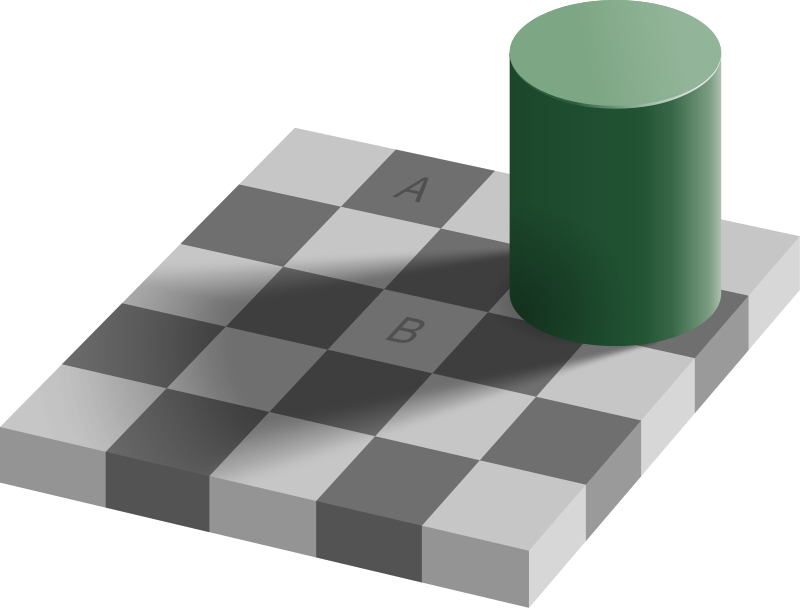
The A and B tiles are exactly the same color
Based on our previous experience, we expect the shaded area “B” to be darker. Our brains account for this and make the B square lighter than it seems. But in reality, both A and B are exactly the same color. No matter how you try to scream and rationalize, you’re fighting against the powerful prediction engine that has been trained over your lifetime to create this simulation.
Hopefully, you’ve come to see reality with new eyes, or with a new hallucination created by your brain.