Web 3.0: Why you should care about it
A radical future may be upon us. Largely hidden from mainstream observers, there has been an influx of smart money and talent into a potentially game-changing version of the internet.
You’ve probably come across terms like Web 3.0, defi, crypto, metaverse - signs that part of this future is already here. As with many groundbreaking phase transitions, there will be plenty of false starts, hype cycles, and mistimed investments. That being said, there’s still a high probability that this future will be realized in one form or another, so it’s worth paying close attention to.
What exactly is Web 3.0?
The best way to understand Web 3.0 is to understand the predecessor phases. Caveat: everything here is a massive oversimplification and there is no “official” definition (I’ve used Chris Dixon’s from a16z), but it should provide a starting framework for your own exploration.
Web 1.0 (Read only)
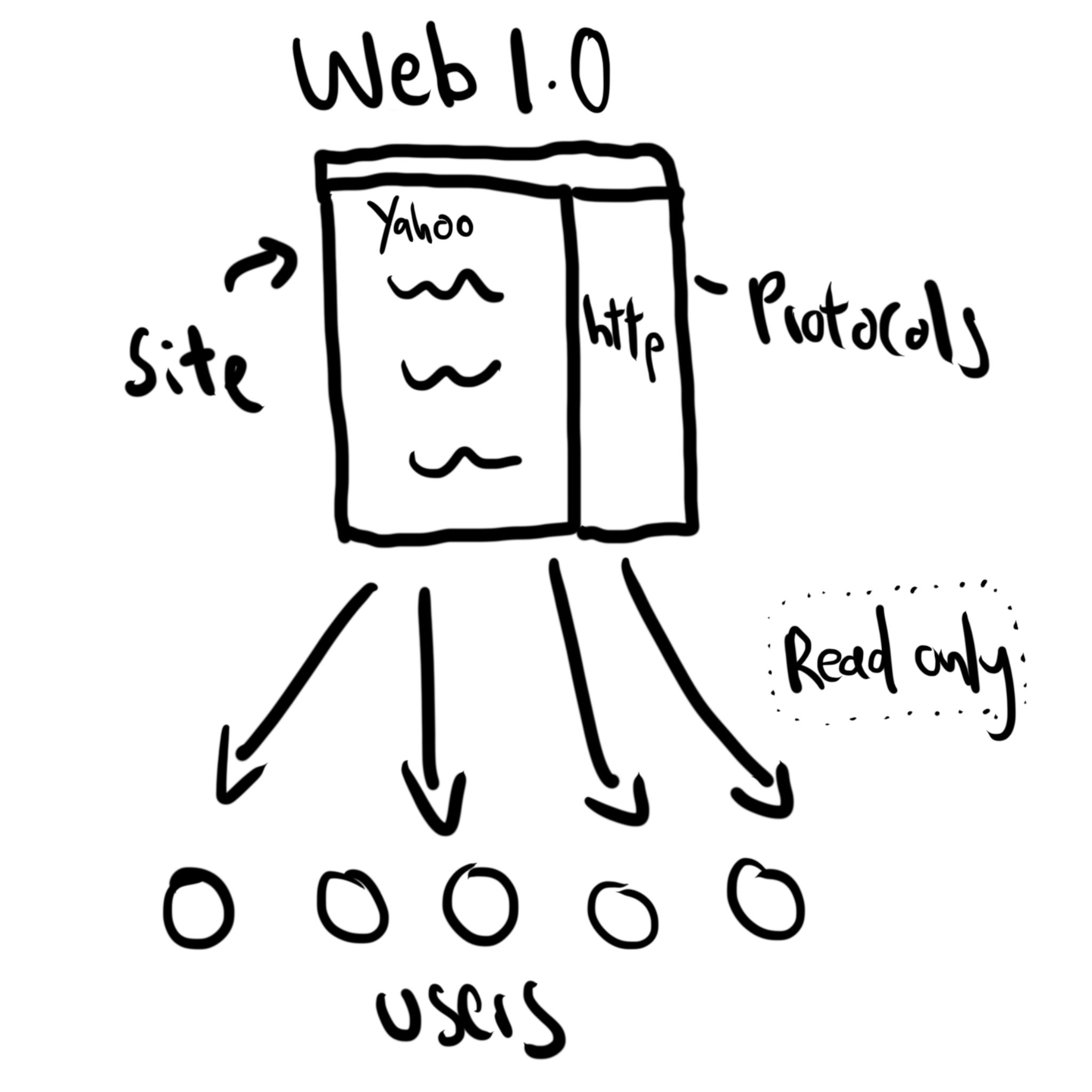
- Shared protocols emerged online (http, smtp), aka the OG internet.
- This allowed people to create platforms based on these protocols that they could fully control (no one can take away). Led to proliferation of first generation, mass distribution websites (google, yahoo, blogs)
- Static sites with little dynamic interactivity, content provided by site, users have no input (read-only)
Web 2.0 (Read & write)
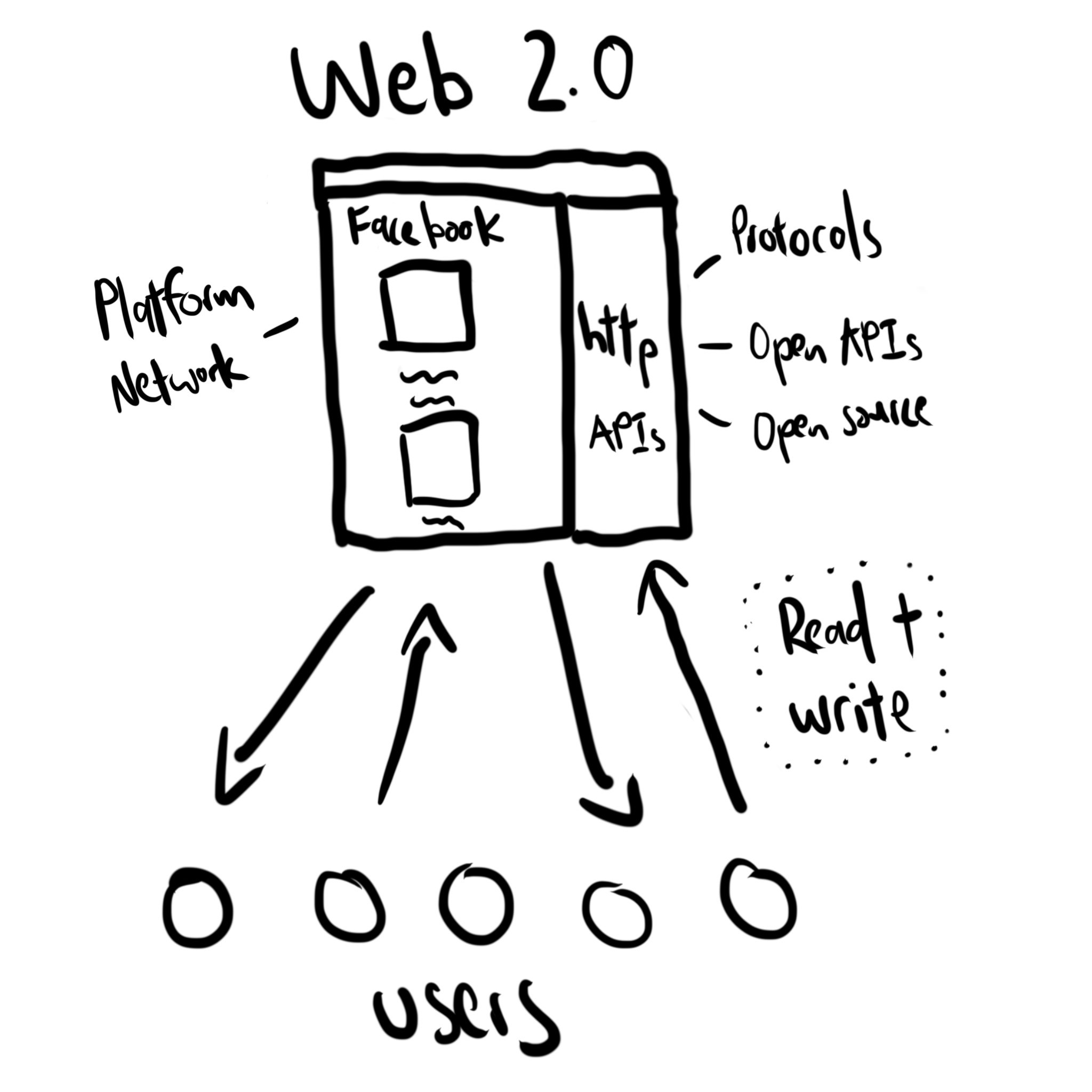
- Emergence of social web. Users can now provide content. (Facebook, twitter)
- Platforms are still wholly owned and controlled by one entity. Users have no say in governance or control.
- You can read & write through contributing content on platforms, but data/content/control is still centralised and not owned by users.
Web 3.0 (Read, write, & own)
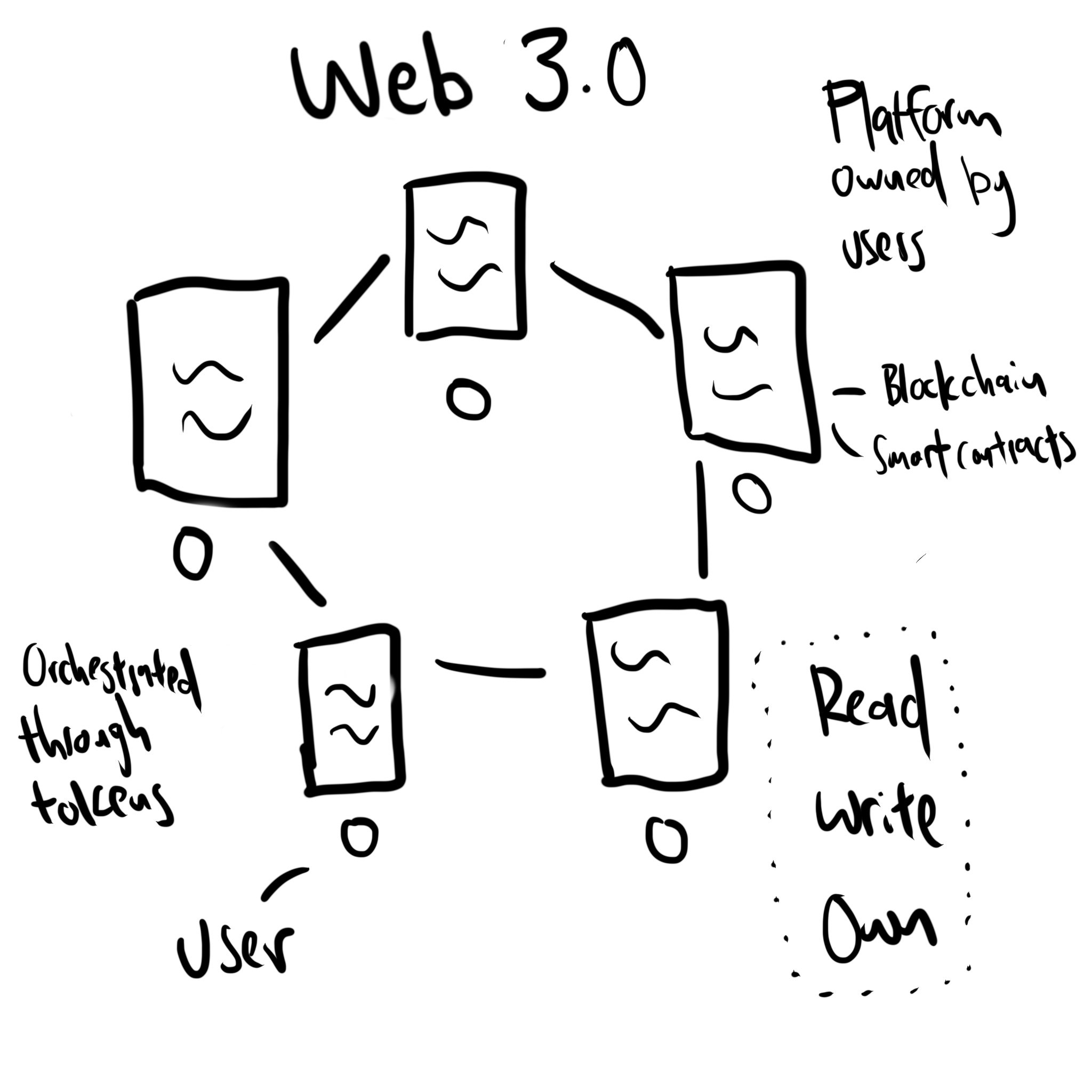
- Internet run on blockchains with 3 key features: decentralized, composable, owned and governed by users.
- Decentralized: Not controlled by single entity - no individual can be censored or denied access. It’s open source code and for first time, open database. Ultimate security since data is secured by personal private keys that no one can access and transactions are mathematically protected.
- Composable: Applications can build on top of each other. Similar to open API concept, but truly open since there’s no gatekeeper. This allows massive innovation since there’s no need to reinvent programs - software version of compounding interest.
- Owned by users: First time in history that users can own real private property on the internet. Creators, designers, builders, contributors, form communities and own a slice of the platform. Tokens are distributed to represent ownership and create financial incentives for governance.
Similar to when Web 1.0 first emerged, there was a lot of initial hype followed by cycles of boom and bust. The level of disruption was simultaneously overhyped and under-appreciated. Many towering digital behemoths collapsed. No one saw the coming boom of e-commerce, social giants, or ride-hailing platforms. Because of the nature of the beast, there will be naysayers, evangelists, cynics, and messiahs. It’s important not to lose sight of the longer arc of history.
What can you do with Web 3.0?
The scope is too broad to cover, but you can start by researching the following.
- Decentralized finance (Defi): Many of the financial services, such as lending, borrowing, exchanges, and derivatives, can be built as applications through smart contracts. (Aave, Uniswap)
- Gaming: Players can own in-game assets and swap them with other players. (Axie Infinity)
- NFTs: Pieces of art that have been tokenized - although this is just one very limited use case. (Bored ape yacht club, Cryptopunks)
- Dentralised Autonomous Organizations (DAOs): Companies that are owned and run by members without any central leadership. Governance and treasury are algorithmically programmed so rules cannot be violated.
How does crypto enable Web 3.0?
Truly digital, decentralized money was the most difficult problem to solve. Whenever something valuable is created, bad actors will appear and attempt to exploit any vulnerabilities. Money is the closest thing to value you can get, creating massive incentives for people to try to steal or cheat the system. Over the past decade, there hasn’t been a single successful attempt in cracking bitcoin - a reflection of the strength of the network.
Now that we’ve solved internet native money, we can now tokenize (in financial jargon, securitize) literally anything, even physical representation of goods. In simple terms, tokenizing means granting proof or representation that you own a piece of something.
The underlying structure of immutable (no one can rewrite historical data) blockchains and decentralized consensus (no single person sustainably controls it) provides the fundamental layer that Web 3.0 is based on. Similar to how HTTP protocols unleashed an unprecedented wave of web innovations, we might be at the precipice of an incoming innovation explosion.
Blockchains that allow programmability (ex. Ethereum, Cardano, Solana), allow smart contracts to be run. These are algorithmically executed agreements programmed into the blockchain code that no one can subsequently reverse.
Smart contracts on blockchains enable the creation of tokens. Tokens are representations of assets or value that run on top of a blockchain.
With tokens, users can own the piece of the platform or service. They are property rights that no one can seize.
Why is this better?
Users, creators, and builders now own a piece of the network, orchestrated through tokens. There has always been an inherent tension between platforms and users. Platforms are owned by companies, which are ultimately answerable to shareholders. Platforms have incentives to extract as much value from users in the network, which they can command through unfair take rates and incontestable algorithmic control. As creators contribute more, platforms accumulate even more value, creating an even larger asymmetry of power. They become digital dictators that benefit from the work of users. This is not to say they are necessarily “evil”, it’s just a matter of misaligned incentives.
When users have tokens and a stake in the platform, they are incentivized to work towards a common goal. Their motivations are aligned to keep the network functioning fairly since they have an economic stake in it.
What about the metaverse?
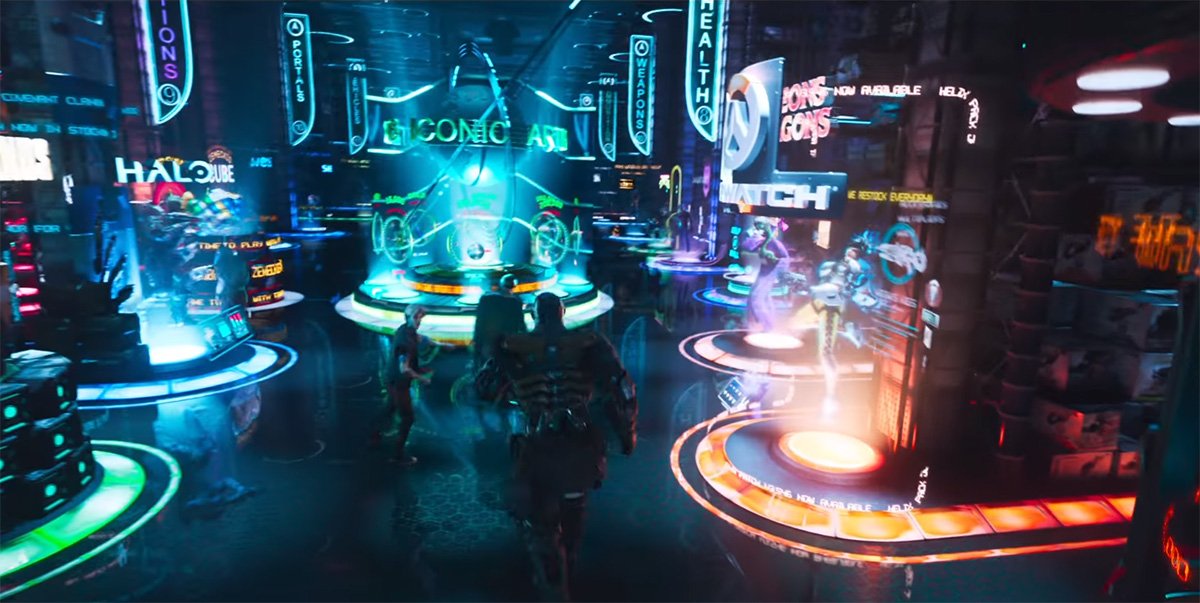
Ready Player One
Just like Web 3.0, there are probably dozens of interpretations when it comes to the metaverse. Simply put, it’s the future of the internet where everything becomes a social, 3D immersive experience. If you’re completely lost, one easy way to visualize this is by watching the movie Ready Player One.
In the past few decades, technology focused on mass virtualization - a race to deconstruct atoms into bits. Think of your alarm clock, it used to be a physical item made up of atoms. Now it exists as software, with bits shuffling around to remind you to wake up. We are now reaching an inflection point where people are looking for more intuitive, visuospatial, and even tactile experiences. As Spotify founder Daniel Ek put it, the tide has now reversed, with companies racing to rebuild the world through virtual atoms.
As more people start accepting this technology (Roblox and Fortnite are current examples), network effects will kick in and potentially create an entrenched ecosystem where most social and business activity will inevitably exist in.
How does the metaverse tie in with Web 3.0?
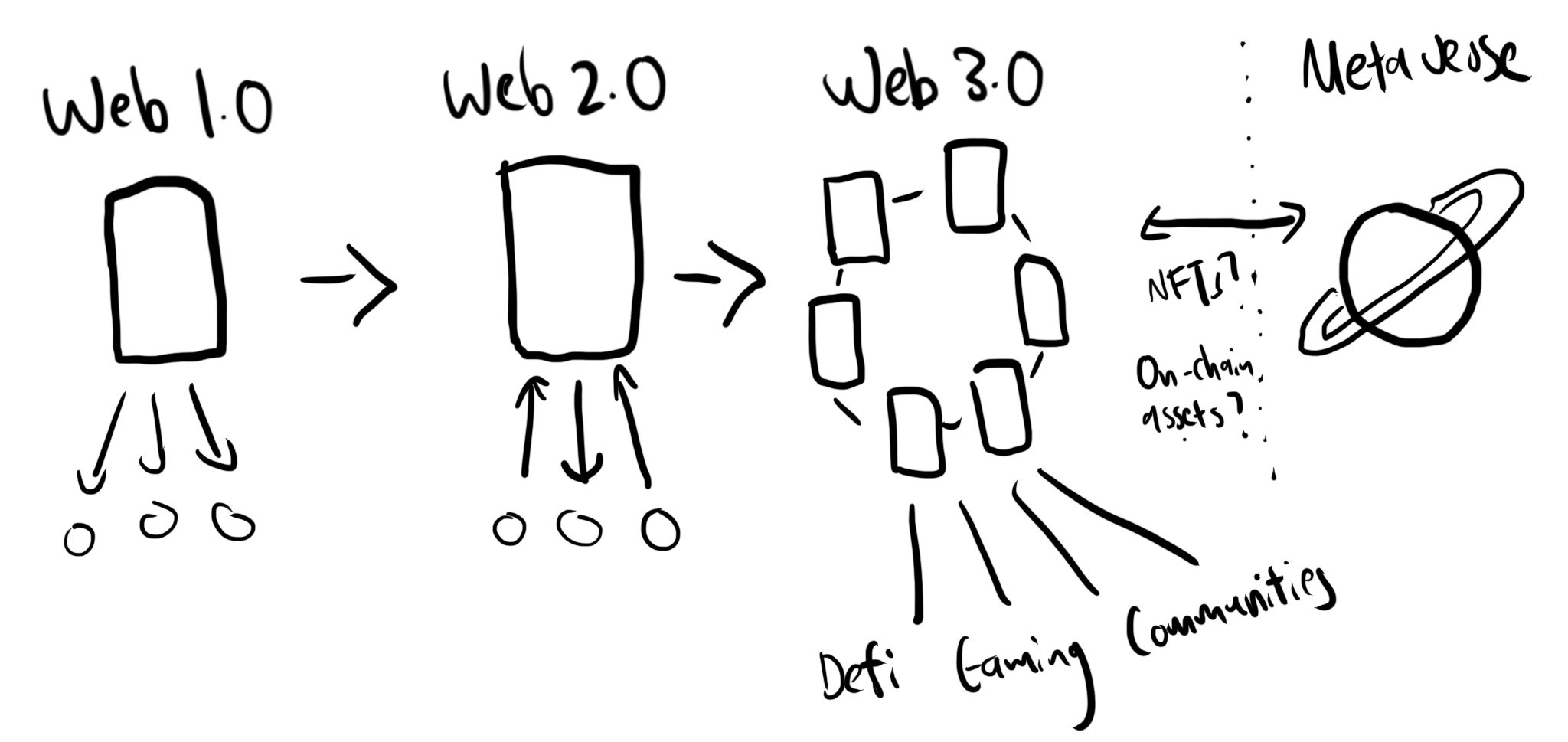
This is where we hit even more speculative territory. There are multiple futures in which the metaverse can be realized. If Meta (Facebook) wins the race, there’s a high chance we’ll be living in a more centralized, Web 2.0 version of the metaverse. The metaverse could also be developed through a more decentralized Web 3.0 approach. Either way, it’s likely that the metaverse will possess digital goods and assets. Imagine a virtual room filled with verified original million-dollar cryptopunk NFTs - you can guess where the cool kids will be hanging out. There might be an interface between whichever metaverse (or perhaps many in a multi-metaverse) dominates and Web 3.0 technologies where cryptoassets play an interconnected role in the ecosystem.
As the saying goes, the future is already here - it’s just not very evenly distributed. This seems to ring especially true at the moment.