Startup mental models: The ultimate playbook
The startup scene is a chaotic and surreal world. Unicorns and decacorns are magically willed into existence through rituals of blood, sweat, and code. In order to thrive in this strange place, you need a relentless focus on the future. Having an irrational sense of optimism with a dose of masochism is another prerequisite to withstand the onslaught of emotional highs and lows. To a fledgling startup trying to find its feet, the real world offers a ruthless command: Grow or die.
“I’m running a startup in some industry. We help our (customer/user/business) get X by changing the way they do Y. We’re planning to be the uber/Facebook/amazon for Z.”
If you operate in a tech or startup environment, I’m sure you’ve come across the statements above dozens of times. How do you begin evaluating if a startup has a shot at building traction? And if they do, how do you help them grow?
I’m far from an expert on this, but I’ve picked up concepts from:
- VCs, investors - Mike Maples (Floodgate Fund), a16z, Ben Horowitz, Naval
- Growth experts - Andrew Chen, Reid Hoffman and many more
- My own humble experience over the years
If you’ve seen my other posts, you’ll know that I’m obsessed with mental models. Rather than approaching each problem with a blank slate, it’s important to have an organized framework of principles to make better decisions. The result is the following list of mental models I’ve consolidated to make sense of the madness that is the startup universe.
If you are new to the startup scene or would like to expand your understanding, this should be the right place for you. It’s the distilled knowledge I find relevant for myself, so take everything with heaps of salt and heed this advice at your own risk.
This is a long post, so I’d recommend you just skip around to the parts you’re interested in:
Part 2: Growth strategy & distribution: acquisition, engagement, retention, referral
Part 3: Business strategy: unit economics, monetization, cost scalability, runway
Part 1: Achieving product-market fit
This is numero uno; the genesis of your adventure. You create something people need - though it’s much easier said than done. The classic idea of product-market fit is to identify the problem scenario that exists, develop your value proposition, and understand why it’s better than existing alternatives. I think this is the minimum checklist to get you going in the right direction, but there are other dimensions not factored in. The main idea of product market fit can be further deconstructed into two sections, insight development, and value hacking. Insight development poses the truth, value hacking validates it.
Insight development
The first step is to have a compelling insight that becomes the foundation for everything else. It’s about knowing something that others don’t know yet. When you’re a newborn startup with virtually no capital, no network, no users, your solution must be contrarian or have something invisible to the public so that it’s dismissed by others initially. If the proposition is obvious enough to be replicated, you will likely be mercilessly gobbled up by bigger players. It’s this hidden knowledge or contrarian approach that gives startups the advantage when they have very few to start with, buying them just breathing room to get some traction before they get too much attention.
These are some of the considerations for insight development.
Earned secret
You should have some knowledge that others don’t. For Airbnb, Brian Chesky realized that when businesses held conferences in a town, there was a surge in demand for hotels. But why did everyone have to stay in expensive hotels? Was there another business model? He quickly tested this by putting ads up for couch surfing, not expecting many people would sign up. Mind you, this was a dark time for the internet and dealing with online strangers in general (period of the “craigslist killer”). The response was overwhelming. He eventually realized the secret, it wasn’t a lack of demand for alternative accommodations, it was the lack of trust. That was the earned secret he discovered, and building trust became the priority that led to eventual success. (through reviews and a host of other things too long to cover here).
Here are the questions you should ask about your own earned secret: - What do know that others do not know, and why don’t they? (is it because no one has thought about it?)
- Why is it a secret (what special perspective do you have makes this non-obvious to everyone else)
- What work has been done to get to this insight? (ensures that it’s not an obvious idea and that some work is required to get there)
Why now? If your idea is so amazing a brilliant, why hasn’t someone done it? Who else has tried and why have they failed? A good answer usually falls under one of these two categories: technology inflection and adoption inflection.
Technology inflection comes when a certain technology develops to an inflection point that now enables a new wave of ideas to flourish. GPS tech or genome sequencing are examples. With GPS technology improved to a point of high reliability and precision, ride-sharing now becomes seamless with easy location tracking. Adoption inflection like the mass adoption of smartphones enabled the development of a new wave of apps and services. This reasoning also works across countries. Because different cities develop their infrastructure and trends at differential rates, their inflection points might arrive at different times. An idea that has worked well in one city might find the right time in another city to launch.
**Idea maze
**It’s not enough to have an idea, you need to explore every previous attempt at the boundary of the idea. There needs to be an honest look at why has something has worked or hasn’t worked in the category. What were the assumptions? Why did it fail? What’s different from my assumptions? What’s changed in the world that makes my assumptions different this time?
**Think wrong
**There needs to be a competitive edge against the incumbent - an orthogonal or asymmetric angle of attack. Follow the opposite convention as a thought experiment. If competitors are charging by subscription, charge by transactions, or give it free and charge users etc.
How to tell if you have product market fit
- Exponential organic growth, mostly from word of mouth
- High net promoter score, but not always ideal
- Measuring sales yield > 1 (Enterprise software)
**Contrarian/ Consensus matrix
**Andy Rachleff was the person who coined the term product market fit. So it’s worthwhile listening to what he has to say on this topic. One of the key mental models he employs is the contrarian/consensus right/wrong matrix.
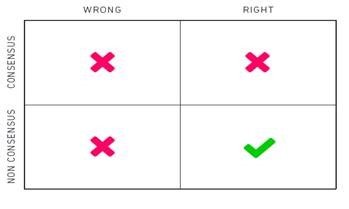
Every new idea fits into a 2x2 matrix. The dimensions are contrarian or consensus, right or wrong. Obviously falling into the “wrong” category means your insight or hypothesis is not going to be validated. However, even if you fall under the right category, it’s not good enough for it to be consensus. This means that other competitors can quickly spot your moves and swoop in to take on any incremental revenue on the opportunity. It leaves very marginal gains because either someone else would’ve done it by now, or it’s vulnerable to copycat attacks by incumbents. The most difficult category to fall into would be contrarian/right. This is where the asymmetric returns come in.
Market size
You need to be crystal clear on who your audience and total addressable market (TAM) is. Your TAM is the potential size of customers that your solution is relevant to. If your TAM is too small, there will be inherent limits to revenue and scale potential. If it’s too large and poorly defined, it’s likely that your solution is too broad or generic to be helpful to anyone.
There’s an alternative school of thought for this that I should mention. Some people insist that pre-launch, TAMs are a myth, and a radical insight is like potential energy waiting to be unleashed into a market that hasn’t existed yet. No one knew what the TAM for social networks was, but it’s obvious once the market for it is created. Anomalies do exist, but unless you are certain of your paradigm-shifting product, it’s better to have a sense of your TAM.
Value hacking
“Value hacking is about seeking the truth rather than selling. If the truth of your value proposition is super compelling, then growth becomes the exercise of syndicating the truth. If the truth of your value proposition isn’t present, you have to grow by throwing money at the problem.” – Mike Maples
Once you’ve qualified your brilliant insight, it’s time to develop a killer value proposition. You need to make sure it ticks the 3 boxes below.
- What can I uniquely do that people are desperate for
- Identify a focus group of customers that desperately need the solution
- Iterate and improve value proposition relentlessly until you reach exponential organic growth
**Minimum Viable Product (MVP)
**Don’t waste time and resources building a perfect product that will launch too late and cost too much. Build a minimum viable product, get feedback, tweak, and deploy again. The worst mistake you can make is not testing your value proposition early enough.
Ship early and ship often.
Only start on growth after you’ve successfully tested your value hypothesis and received validation through your MVP. If not, you’ll just be burning through cash on customer acquisition that will lead to fake and unsustainable growth. Use low-cost growth hacks to test your hypothesis.
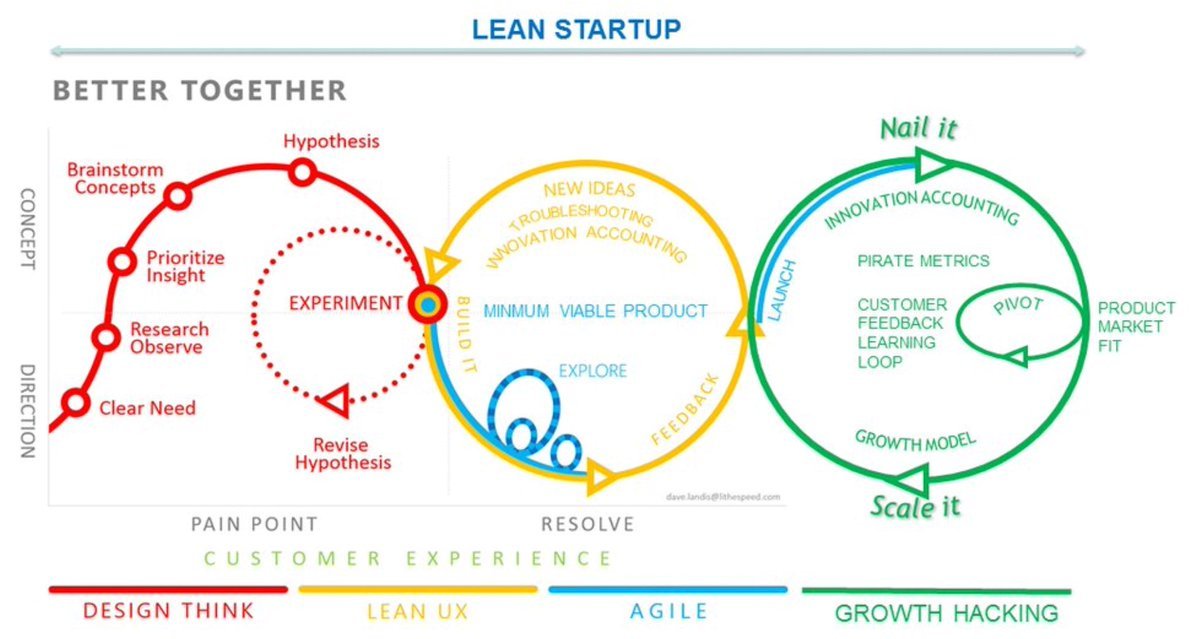
This illustration by John Cutler shows how these components fit nicely. There is too much information to break down in this, but if you are serious about building a product, it’s important to understand the concepts of design thinking, lean startups, and agile product management.
Creating a story that resonates
Now that you have a value proposition and you’re set for growth, there’s an additional high-level step to look at: packaging it into a story. Why? Because humans naturally think in narratives. Your ability to tell stories will determine your startup’s success. It’s not just about marketing or branding. A convincing story will help you recruit your first employees, acquire your first customers, and get early investors to fund your startup.
Matching a person’s worldview: In Seth Godin’s book, All marketers tell stories, the core message is that everyone comes with a worldview. They will believe whatever fits their worldview, so the goal is to create an authentic story that fits that frame.
Your job isn’t to convince people to want what you offer, but to help them to convince themselves that what you’re offering will get them what they want.
Hero’s journey: This is a story structure that is found universally. It captures the essence of an adventure that ultimately transforms the protagonist.
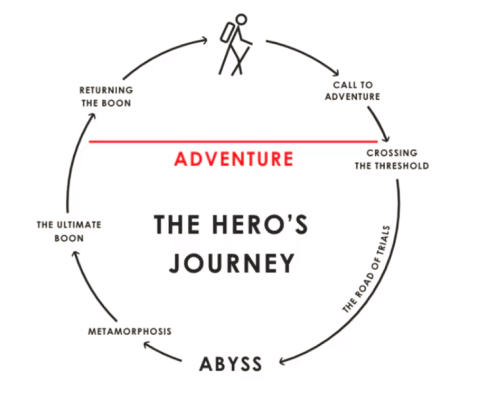
Source: Principles, Ray Dalio
Most popular narratives fit this 4 part structure
- Call to adventure
- Crossing the threshold into a new world of trials
- The abyss
- The ultimate boon and back to normal life
This story template has been used from classic Disney films, Star Wars, to Rick and Morty. The idea is to make your user the hero of this journey, inviting them to an adventure that will ultimately change their life.
Part 2: Growth strategy and distribution
With strong insight and a validated value proposition (in the form of a solid product), it’s time to get people to use it. This is where growth strategy comes in. Most of this framework will be within the context of a platform that grows through users, since it’s the area I’m most familiar with.
Rather than randomly throwing darts in an attempt to score a viral bullseye, it’s better to have a systematic approach to growth. You can break it down to 3 main components, acquisition, engagement, retention, and work out what needs to be measured and done with each bucket.
Acquisition How is the company acquiring new users? Employ the common practice of agile product management: Experiment at high velocity, get data, iterate and optimise across channels. Using channels are the standard approach at the early to mid-stages, and even when you have a big base of users, but the end goal would be to build scalable loops.
Standard channels (fast, easy to deploy, not scalable)
SEO: Takes time to build good content and backlinks. However, once you have high ranking pages, you get to reap the value for a long period.
SEM/FB ads: Fastest way to get conversions with the ability to continuously experiment and optimize for ROI. Can be costly and lead to unsustainable traction in the long run if not managed correctly.
Email: Great for engagement, but faces a cold start problem when there are very few initial customers.
Social: Cheap, but popular channels are saturated. Tap into newer channels and platforms to see if you get better ROI on time.
Content Marketing: Nothing beats solid, genuinely engaging content. Requires talent and time to create something compelling that can cut through the noise.
Building loops (slow, hard to deploy, more scalable)
Leveraging existing platforms or partners: Acquiring users directly can be expensive. A better way would be to tap into an existing user base through direct platform integrations or partnerships. AirBnB convinced hosts to cross post on craigslist, developing a button that could help them seamless integrate their listing to their craigslist post. PayPal tapped on eBay by adding a pay by PayPal function, greatly increasing their reach in the early days.
Viral mechanics: Dropbox rewarding users with more data for referring, setting up university competitions and awarding all students in winning university with more data (NUS won this competition globally)
Acquisition loops: Encouraging user generated content (UGC) on a site by adding reviews > more relevant content on page > better SEO ranking> more traffic > more UGC
**Engagement
**Once you’ve acquired users, you need to assess how much they’re actually using your product. Acquisition is just the tip of the iceberg. The real goldmine is in engagement - here are the two common ways to look at it.
Frequency: How often do your users use your product? This can be plotted with a frequency histogram called a power user curve. Most social apps can be analyzed in a 28-day timeframe (famously used by Facebook as L28). For high-frequency daily use apps, the curve should be highest on the left (with many users opening the app once or twice a month), followed by a slope downwards towards the right. In very successful apps, there will be a sudden spike upwards towards the end, since there will be a group of power users that use the app almost every day. You will need to use the appropriate frequency metric for your product’s desired behavior. You wouldn’t expect people to use AirBnB on a daily or monthly basis, so you would need to adjust your metric targets to suit realistic user behavior.

Example of a really good Power User Curve by a16z
Session activity: It’s not all about how frequently users engage with the product, but what they do when they’re on it. Having a long session duration or high activity during a session is also extremely useful in gauging value. Despite experiencing slower recent growth, Pinterest is known for its jaw-dropping engagement numbers.
Measure DAU/MAU
Calculate the ratio of daily active users (DAU) over monthly active users (MAU). This shows how many days a month a user is actively engaged in your product. MAU numbers can be easy to artificially inflate with paid marketing. It’s harder to fake this ratio because if you use unsustainable means of getting people to open your app, you can easily inflate MAU numbers. But because they only open it that one time, they don’t come back regularly and your DAU number will suffer. It’s a true quality indicator of how engaged your users are.
**Retention
**There’s no point in acquiring users if you aren’t able to retain them. Picture a leaky bucket. Users are might be added in, by if they’re leaving the bucket at high rates, the overall amount of users will eventually plateau or even start shrinking.
How to measure retention
The standard approach is to track your users by cohorts and measure the quality of these cohorts over time. What you are trying to determine is that for each batch of users coming in during a period, how many of them drop off or come back later on. For example, for users acquired in month 1, what % of them actually continue using the product the next month? Compare the retention curves for month 2,3,4 and so on, to see if your retention rates are improving. Work backwards to identify which parts of the user journey do they fall out from and why they are not returning. Track if new product features, onboarding improvements, or drip marketing efforts lead to better cohorts over time.
Getting users hooked
The best way to gain retention is to make your product or service a habit for your users. This formula is adopted from Hooked, but it plays into the basic psychology of building habits.
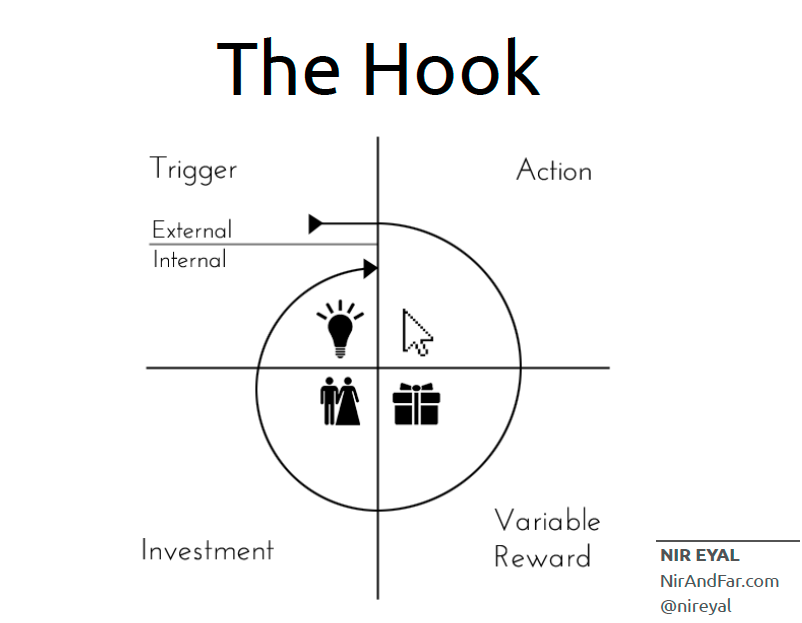
Trigger: Every behaviour requires a trigger. Can be external (push notification) or internal (feeling bored and clicking on instagram). Ideal scenario is associate a specific need or emotion with your product and create internal triggers.
Action: In order to increase the likelihood of a desired action or conversion occurring, the cost of the action has to be minimal. This means a seamless, low cognitive effort user experience.
Variable reward: There needs to be a reward in order to drive the motivation of the user. Fixed rewards are not as effective as variable rewards. Think of jackpots and instagram. You scroll endlessly for a chance of a dopamine hit, which trains your brain to crave that anticipation and develop a robust addiction to the action (as you can imagine, this can exploited negatively).
Investment: To complete the loop, the user needs to invest some effort into the action. This creates a commitment bias and rationalization to use the app again.
Engagement versus Retention
These two aspects are usually blurred because they both involve “keeping the user activated”. Engagement is usually about frequency, while retention is about how long they continue to use the product. For example, weather apps can have low engagement high retention - people only check them when needed but tend to use the same app over long periods, whereas mobile games tend to have high engagement low retention - they play incessantly until they switch over to a new game.
**Checklist for startups (adapted from Andrew Chen)
**1) Is it working? - organic acquisition >60%
- DAU/MAU >50% (how much of it is habit?)
- power user curves
- Cohort retention curves (stickiness)
- actives/signups (validates TAM)
2) If it is working, can it scale?
- what channels are being used
3) What can we do with product to amplify.
Optimize acquisition > activation > retention > reactivation
Part 3: Business strategy
You have regular users coming in and they’re happy with your app or buying your products, but are you actually making money? The standard approach would be looking at your net income. The issue is that many startups would probably be less than a year old and lack sufficient financial data. Even if they were a few years old, it’s likely that they would be burning through cash for acquisition or tech investments, which makes it hard to determine if the business is actually sustainable in the long run.
Unit economics: How to tell if you have a sustainable business.
There’s a simple equation, CAC < LTV. That formula represents the unit economics of the business, here’s the breakdown:
Customer Acquisition Cost (CAC): Cost of acquiring one customer. If you have paid marketing, it would be your amount spent divided by the amount of new users acquired for that period.
Lifetime value (LTV): This is the lifetime value of the customer, or how much the money you will earn from the user over his/her through the product usage cycle.
The rest is simple unit economics. If your cost of acquiring one customer is lower than the lifetime value of the customer, in principle, you have a sustainable business in the long-run (theoretically speaking).
Of course, CACs never usually stays the same. There are several variables that change as market share increases. As you grow, you could tap into referral mechanics or network effects (see below), which might lower your CAC. You might also start saturating the total amount of users in your addressable market, making it more costly to acquire each new user over time. Certain acquisition channels might become more expensive over time, and newer, more effective channels might pop up.
LTVs are rarely stable as well. Earlier assumptions might not factor in external changes such as competitive threats. You might also develop new retention techniques (increase LTV by increasing usage length) and monetisation strategies (extract more conversions or basket sizes per month) that will increase your LTV.
The point is to plan with some assumptions in mind, but the users and markets are dynamic, so don’t let your projections lead you off a cliff.
Monetization
Essentially how you earn from your product. I’ll cover a few basic models, but there are many other creative options out there.
1. Profit margin from selling products/services: This one is obvious enough, but there are two strategies. Either have a high profit margin but potentially lower sales volume, or go for high volumes with lower margins. Enterprise software products usually fit the first bucket, taking on expensive sales and onboarding costs but with very high margins. E-commerce falls on the other end of the spectrum, which high transaction volumes but low margins.
2. Transaction fees: Think stripe or AirBnB, basically taking a cut from each transaction for a commission.
3. Subscriptions: Great for recurring revenue and stickiness, tough for initial traction because of high commitment barriers.
4. Media space: Selling eyeballs and traffic through ad space. Unless you’re a large publisher or content player with massive traffic, I’d highly discourage this route. Least profitable considering current CPM rates. If you really receive a ton of traffic, there are better ways to monetize.
5. Affiliate: Generating demand through your website and selling the leads. Either charge by lead generated or completed conversion (if online). Commission can be based on fixed conversion or % of revenue generated.
**Cost scalability
**As your company continues to grow, costs tend to scale as well. Ideally, your startup cost of production should fall into one of these categories.
Economies of scale: The more you produce, the cheaper it should be to produce more products. Mostly for physical goods or platforms with deep integration effort required.
Marginal cost of replication close to zero: For each customer you acquire, it shouldn’t increase your costs as much. Applies to most platform startups like e-commerce where it doesn’t have an additional cost to offer a service, aside from incremental onboarding/maintenance costs.
Fixed costs: Ideal scenario where the platform or software is hands-free. Having 10 users or 10,000 users will incur the same costs. Think social networks or online Saas applications.
If you do not have sublinear cost scaling (cost goes down per user/customer), then you have to accept that the growth of your business will always be limited. Linear costs occur for most businesses that involve artisanal/curated goods.
**Runway and cash flow
**Cash is the lifeblood of your venture. Once you’re out of it, the game is mostly over (unless you’re a single founder with no staff, fixed costs, or a desire to live a comfortable life). The first step in figuring out your runway is understanding your monthly burn rate. Your burn rate is the amount you are losing each month (fixed + variable costs - revenue). You then calculate your runway by diving your current cash balance by your burn rate. This should give you the number of months you have left from a cataclysmic end. Good runway >12 months. Great > 2 years. Fucked < 3 months.
Part 4: Network effects
Networks dominate most of the modern tech landscape, yet many people don’t have a basic understanding of the concepts from this field. If you look at some of the most valuable companies in the 1990s (General Electric, Shell, Coca Cola), they reached that status through massive economies of scale and solid brand positioning. In the age of tech, a new type of competitive advantage has taken over: Network effects.
**What are network effects?
**Simply put, it’s when an addition of a user (or node, merchant, agent) increases the value of the entire network (users, product, service).
A basic example would be a social network. With one user (or node), the network is pretty much useless. With each addition of a user, it becomes more useful to all the users, since they are able to then interact and share information with other users. The value of the entire network thus increases in a non-linear (geometric vs linear) fashion with the addition of more nodes.
It might seem quite obvious, but there’s a hidden magic to network effects. As more nodes are added to the network, the value of the network starts to compound, making it even more attractive to new users. This creates a positive feedback loop of value creation that leads to a winner-take-all or winner-take-most scenario. This superlinear growth creates a competitive advantage that makes it hard for new competitors to break in because of the high switching costs of existing users in another network.
There are many different types of network effects. You can find a great and much more detailed explanation by NFX here.
Here are 3 broad groups of network effects that are more relevant to tech startups.
Direct network effects: Adding more users directly increases the value of the network. Social networks, WhatsApp, linkedin etc.
Indirect network effects: Increase in users adds more value to the overall ecosystem. Shopify, Microsoft operating systems, or the Apple App Store. As more users add more apps, the platform becomes more useful.
Two-sided network effects or marketplaces: Adding more users or merchants on one side of the network increases the value for the other side. Uber adds more drivers, which becomes more useful for riders, then becomes more valuable for drivers. Chope (the place I work at currently), also has two-sided network effects. More restaurants mean more value for users, which drives more users and becomes more valuable for restaurants.
Network effect businesses face a cold start problem, because they are initially worthless without a network. It requires heavy subsidy and aggressive growth. But once a certain critical mass is reached, they can lead to superlinear growth, increased retention (due to high switching costs), and strong defensibility (hard for new entrants to come in and compete with existing network).
End
This list of mental models is far from exhaustive and will continue to evolve, but it should provide a good foundation for anyone new to this wacky world. Each point here probably deserves a book on its own, so I encourage you to explore these topics further and let me know if I’ve missed anything critical!